
CELEBRITY
🚨 NAVY NAMING CONTROVERSY! DONALD TRUMP REPORTEDLY SEEKS TO PUT HIS OWN NAME ON A U.S. AIRCRAFT CARRIER ORIGINALLY DESTINED TO HONOR A BLACK PEARL HARBOR HERO — SHOCKING RENAME DISCUSSIONS SPARK OUTRAGE, RAISE QUESTIONS ABOUT RESPECT FOR MILITARY SERVICE AND REIGNITE DEBATE OVER HOW AMERICA HONORS ITS FALLEN HEROES! 🇺🇸⚓🔥

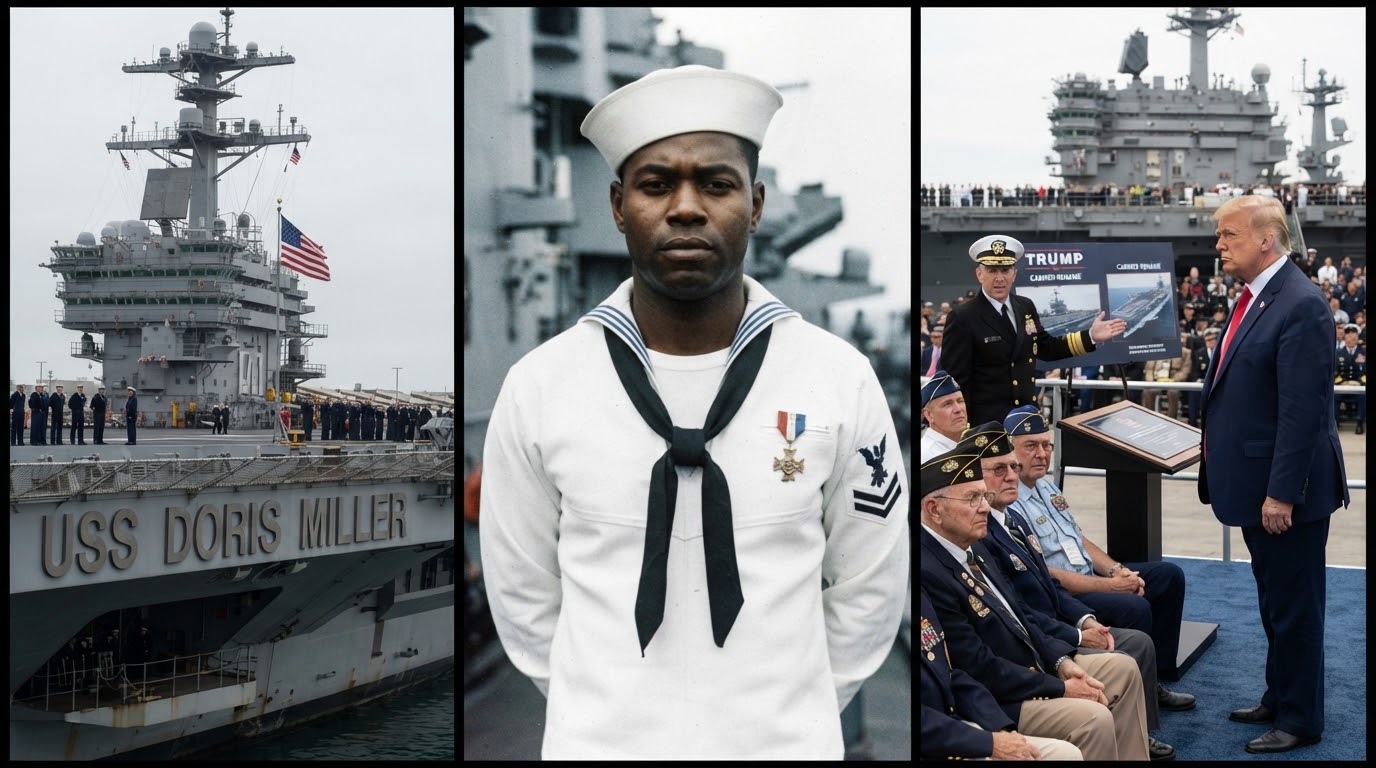
A major controversy surrounding Donald Trump and the United States Navy has reignited a heated national debate over presidential recognition, military service and the legacy of America’s forgotten heroes.
The controversy emerged after reports revealed that Navy officials had discussed potentially renaming an aircraft carrier originally designated to honor Doris “Dorie” Miller, a Black American sailor celebrated for his extraordinary bravery during the Japanese attack on Pearl Harbor in 1941.
According to reporting by CNN, two sources familiar with internal discussions said that naming the carrier after President Donald Trump had been considered.

The possibility immediately attracted attention, particularly because the USS Doris Miller was expected to make history as the first American aircraft carrier named after an African American and an enlisted service member.
For many observers, the controversy raised an uncomfortable question: should a warship already designated to recognize a decorated military hero be renamed to honor a sitting president?
Doris Miller: The Pearl Harbor hero whose legacy is at the centre of the controversy
Doris Miller’s story remains one of extraordinary courage in American military history.
Serving aboard the USS West Virginia during the attack on Pearl Harbor on December 7, 1941, Miller helped move wounded sailors to safety and operated an anti-aircraft gun despite having no formal training on the weapon.
His actions earned him the Navy Cross in 1942, making him the first African American sailor to receive the prestigious military decoration.

Miller’s bravery became an important part of America’s wartime history, particularly during an era when Black service members faced widespread racial discrimination.
He later died in November 1943 when the USS Liscome Bay was torpedoed during the Battle of Makin.
The decision to name an aircraft carrier after him was therefore more than a ceremonial gesture. It represented recognition of a sailor whose courage helped save American lives and whose contribution deserved national remembrance.

Donna Kelce and Andrea Swift Steal the Show at Arrowhead Stadium as They Pose Together While Travis Kelce Warms Up for Chiefs vs. Cardinals Clash!

BREAKING: Marcus Rashford spotted with Raheem Sterling’s wife, in a secret romantic vacation at the beach Paige Milian, after the pair left a hotel together Rashford seems to be enjoying this break with his former teammate’s wife more than anyone else!

🚨 NAVY NAMING CONTROVERSY! DONALD TRUMP REPORTEDLY SEEKS TO PUT HIS OWN NAME ON A U.S. AIRCRAFT CARRIER ORIGINALLY DESTINED TO HONOR A BLACK PEARL HARBOR HERO — SHOCKING RENAME DISCUSSIONS SPARK OUTRAGE, RAISE QUESTIONS ABOUT RESPECT FOR MILITARY SERVICE AND REIGNITE DEBATE OVER HOW AMERICA HONORS ITS FALLEN HEROES! 🇺🇸⚓🔥

🚨 JUST IN: TRUMP DROPS BOMBSHELL ON FBI HACK! President Says Breach Could Uncover Hidden Truths About Russia Investigation and Alleged Voter Fraud: “MAYBE WE’LL LEARN THINGS WE WOULD HAVE NEVER LEARNED OTHERWISE!”

BREAKING: Donald Trump suddenly crashes to the ground and faints moments after finishing his conversation with journalists following his return to the United States from the 2026 APEC Summit in China, as journalists rush to his side and accidentally capture his swollen back bulge and nearly falling toupee, but what one journalist’s camera reveals moments before his fall raises serious questions about why he was still elected president

BREAKING: SENATE DELIVERS MAJOR VICTORY FOR TRUMP! 62–33 Vote Sends Sweeping Affordability and Permitting Bill Forward as Americans Hope for Lower Costs and Economic Relief!

🚨💔 BREAKING: DREAM BAHAMAS GETAWAY TURNS INTO A TERRIFYING NIGHTMARE! 😱🌊 TAYLOR SWIFT, 36, AND TRAVIS KELCE, 37, REPORTEDLY CAUGHT UP IN A SHOCKING SHIPWRECK SCARE DURING THE CHIEFS’ BYE WEEK! 💔🚨 Taylor Is Rushed to the Hospital as a DEVASTATED Travis Is Reportedly Left in Tears! 😢 What Really Happened in the Bahamas? A Romantic Escape Takes a SHOCKING TURN! 😱

🚨🔥 ROYAL MEETS NFL ON TAYLOR SWIFT’S PRIVATE JET! 😱✈️ TAYLOR SWIFT, TRAVIS KELCE, PATRICK AND PREGNANT BRITTANY MAHOMES CAUGHT TAKING ADORABLE SELFIES ALONGSIDE PRINCE WILLIAM AND KATE MIDDLETON AFTER THE 60TH CMA AWARDS! 👑❤️ BUT WHAT HAPPENED ON THE FLIGHT BACK TO KANSAS HAS FANS LOSING THEIR MINDS! 📸🔥

❤️🔥 BREAKING: TAYLOR SWIFT, 36, AND TRAVIS KELCE, 37, ESCAPE FOR A ROMANTIC GETAWAY AFTER THE CMA AWARDS! 😍🏝️✨ Following Their Show-Stopping Night at the CMAs, the Power Couple Are Reportedly Enjoying Some Private Time Together — But ONE UNEXPECTED DETAIL About Their Post-Awards Escape Has Fans BUZZING! 💕👀

🔥🚨 BEACH GETAWAY EXPLODES INTO A GLOBAL SENSATION! TAYLOR SWIFT AND TRAVIS KELCE TURN THEIR ROMANTIC VACATION INTO A SHOW-STOPPING SPECTACLE! 😱❤️🏖️ EVERY MOVE, EVERY MOMENT, EVERY GLANCE HAS FANS LOSING THEIR MINDS — AND THE INTERNET CAN’T STOP TALKING! JUST WHEN THE WORLD THOUGHT THIS POWER COUPLE COULDN’T GET ANY MORE ATTENTION, THEY STEAL THE SPOTLIGHT AGAIN! 💥🔥

NFL WAGs Brittany Mahomes and Taylor Swift Steal the Spotlight at the 60th CMA Awards as They Pose Together in Stunning Red-Carpet Moment
