
NFL
JUST IN: Congressman Randy Fine demands passage of his bill to ban dual citizens from serving in Congress…

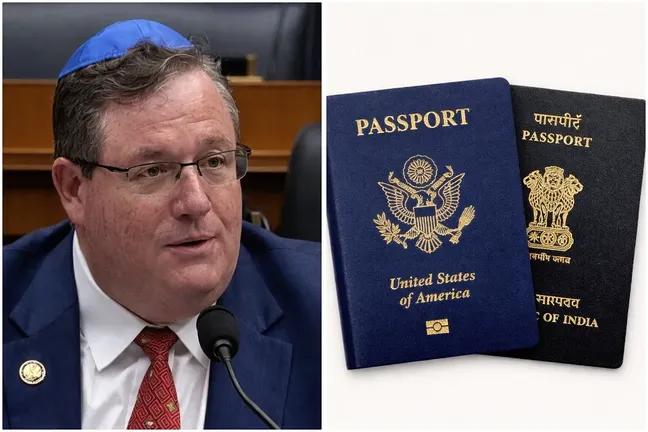
Congressman Randy Fine Demands Passage of Bill to Ban Dual Citizens from Serving in Congress
In a renewed push amid ongoing debates over loyalty and national priorities, U.S. Representative Randy Fine (R-FL) has called for the immediate passage of his legislation aimed at prohibiting individuals with dual citizenship from serving in the United States Congress.

The bill, officially titled the Disqualifying Dual Loyalty Act (introduced as H.R. 5817 in late 2025), would bar anyone holding citizenship in a foreign country from being elected to or continuing to serve in the House of Representatives or the Senate. Candidates would be required to renounce any non-U.S. citizenship prior to election, and current members with dual citizenship would need to relinquish their foreign allegiance if seeking reelection.
Fine, representing Florida’s 6th congressional district, has framed the measure as a straightforward matter of undivided allegiance. “You can only swear allegiance to one country,” he stated in recent remarks. “If you’re in Congress, that allegiance should be to America.” He emphasized that the legislation ensures lawmakers are “fully committed to our country, not divided between two.”
The congressman has argued that while dual citizenship may be acceptable for private citizens in an increasingly globalized world, it poses an unacceptable risk for those entrusted with shaping U.S. national policy and security. He has pointed to potential conflicts of interest, questioning scenarios such as dual citizens working in sensitive roles like at the CIA if their other nationality involves a nation with adversarial relations to the U.S.
Fine’s renewed demand for passage comes as viral posts and discussions on social media platforms like X (formerly Twitter) highlight the proposal, with supporters describing it as “common sense” and “America First” policy. Critics and observers have noted that the bill could affect members who hold citizenship from countries of origin, particularly among immigrant-background lawmakers—many of whom are Democrats, according to Fine’s comments.

The congressman has also addressed motivations behind the bill, stating it counters baseless accusations of divided loyalties, including antisemitic claims directed at Jewish members of Congress (Fine himself is Jewish). He has clarified that the measure is not retroactive in a punitive sense—individuals could renounce foreign citizenship to continue or pursue service—but aims to set a clear standard moving forward.
Introduced in October 2025, the bill was referred to the House Committee on the Judiciary (with some reports noting initial referral to House Administration). It has yet to advance significantly through the legislative process, facing uncertain prospects in a divided Congress. No official tally exists of current members with dual citizenship, as disclosure is not currently required.
Fine’s push aligns with broader “America First” themes in recent political discourse, though it has drawn attention to complex issues surrounding immigration, naturalization, and constitutional qualifications for office. The U.S. Constitution sets basic eligibility for Congress (age, citizenship duration, and residency), but does not explicitly address dual nationality.
As debates continue, Fine’s call underscores ongoing tensions over loyalty, representation, and who should make laws for the American people. Whether the bill gains traction remains to be seen, but it has reignited conversations about the intersection of personal identity, national allegiance, and public service.

News update : 9-Year-Old Cory Skipper Miller Delivers Powerful Speech at New York Town Hall, Challenging Trump’s Policies…

Breaking : . Trump’s a Monster. Why the Hell Is He Still Occupying the White House?

Just in : Trump with Howard Lutnick: “I don’t understand why the Jeffrey Epstein case would be of interest to anybody. It’s pretty boring stuff.”

71% of Americans believe the U.S. is out of control under Trump, according to survey. If you agree with me, say hi in the comment section…

Senator Chris Murphy: Republicans are not willing to do anything, so for now, Trump and his friends will get away with their crimes. But the rule of law is COMING BACK. When it does, everyone who has traded government favors for cash are going to JAIL. Do you agree with Chris Murphy?

JUST IN: President Donald Trump said he would accept the results of the 2026 U.S. midterm elections only if he believes they are honest

Thomas Massie: We should cancel Presidents’ Day until we have a ‘REAL’ president — one who builds this country up instead of DESTROY IT!!

JUST IN- They’ve identified the White House staffer that posted the racists meme on social media. Here is his picture. Hope they do the right thing and fire the staffer. 😡 😢 Raise your hand if you want Trump impeached immediately ✋

Do you believe Kamala Harris would be doing a far better job than Donald Trump if she were president right now ✋ Read more below 👇🏾👇🏾👇🏾

President Donald Trump has confirmed that no staffer has been fired or disciplined over a controversial video posted to his social media account that included a racist depiction of former President Barack Obama and former First Lady Michelle Obama…

BREAKING : Gail Slater, who ran the antitrust division for the Justice Department for nearly a year, was fired by the administration this week after months of being at odds with Attorney General Pam Bondi, per two sources familiar with her ouster…
