
CELEBRITY
Elon Musk is the first person ever to reach a $800,000,000,000 net worth. But Musk recently doubled down on the idea that “money can’t buy happiness.” When you own the stars, the platforms, and the future of transport, what is left to chase?

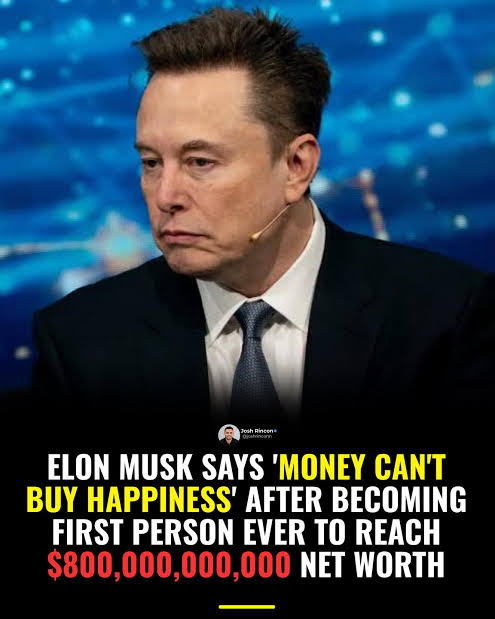
Elon Musk has once again rewritten the record books. In early February 2026, following the blockbuster merger of his aerospace powerhouse SpaceX with his artificial intelligence venture xAI—valuing the combined entity at an astonishing $1.25 trillion—the world’s most prominent innovator became the first person in history to surpass an $800 billion net worth.
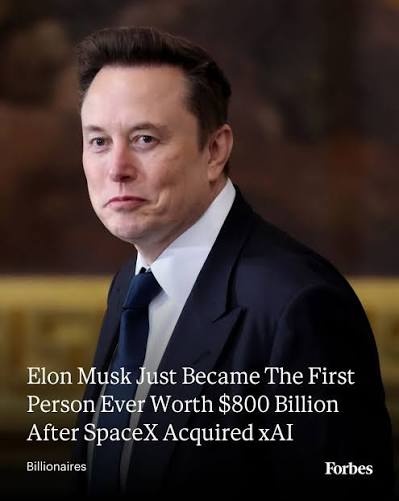
Estimates from Forbes placed his fortune around $852 billion shortly after the deal, with other sources hovering near $845–$850 billion. This milestone eclipses previous peaks, making Musk’s wealth larger than the combined fortunes of the next several richest individuals and dwarfing entire national economies.
Yet, in the shadow of this unprecedented financial summit, Musk doubled down on a timeless refrain. Posting on X (the platform he owns), he wrote: “Whoever said ‘money can’t buy happiness’ really knew what they were talking about 😔.” The message, simple and somber, arrived amid headlines celebrating his ascent and sparked immediate reactions—from memes and skepticism to philosophical debates. Billionaire Mark Cuban weighed in, suggesting money amplifies existing circumstances: if you’re miserable without it, more wealth might only magnify the misery.
This juxtaposition raises a profound question: When you already “own” slices of the stars through SpaceX’s Mars ambitions, dominate global digital discourse via X, revolutionize transportation and energy with Tesla, and shape the future of intelligence with xAI and Neuralink, what remains to chase? Musk’s empire spans electric vehicles that have accelerated the world’s shift away from fossil fuels, reusable rockets that have slashed space launch costs, satellite constellations blanketing the planet with internet access, and AI pursuits aiming to understand the universe itself. His ventures aren’t just businesses—they’re bets on humanity’s long-term survival and expansion.
For Musk, the pursuit has never been purely about accumulation. He has repeatedly described his wealth as largely “paper” value—tied to company stakes rather than liquid cash (he has claimed less than 0.1% in cash holdings)—and positions himself as “cash poor” despite the headlines. His drive stems from existential imperatives: making life multi-planetary to safeguard against Earth-bound catastrophes, advancing sustainable energy to combat climate collapse, and developing AI that aligns with human flourishing rather than threatening it. These are not problems solvable by writing bigger checks; they demand relentless innovation, risk-taking, and often personal sacrifice.
Happiness, as Musk’s post implies, eludes even those who command such resources. Psychological research supports the nuance: money reliably boosts well-being up to a point—covering basic needs, security, and experiences—but beyond that threshold (often cited around six-figure annual income in studies, far below billionaire levels), additional wealth yields diminishing emotional returns. For the ultra-wealthy, isolation, scrutiny, fractured relationships, and the pressure of outsized responsibility can erode joy. Musk’s life—marked by intense work schedules, public controversies, family complexities, and the constant weight of his ambitions—illustrates this vividly.
So what is left to chase when material ceilings have been shattered? The answer lies in Musk’s own rhetoric and actions. He speaks of colonizing Mars as insurance for consciousness, of preserving free speech as essential to progress, of accelerating scientific discovery to unlock deeper truths about reality. These are civilizational quests, not personal indulgences. The “stars” aren’t metaphorical for him; they represent the next frontier where humanity must go to endure. Platforms like X are tools for collective truth-seeking in an era of information overload. Transport innovations aim to free humanity from geographic and energetic constraints.
In this light, Musk’s chase transcends wealth. It’s about legacy on a species scale—ensuring humanity doesn’t stagnate or self-destruct. Money, even at $800 billion+, is merely fuel for that rocket. Happiness may remain elusive, a byproduct rather than the goal, but the mission endures: push boundaries further, faster, for a future where humanity thrives beyond one fragile planet.
As Musk hurtles toward potential trillionaire status—analysts speculate it could arrive later in 2026 or soon after—the paradox sharpens. He controls more resources than any individual ever has, yet insists the one thing money can’t secure is the very thing many chase wealth to find. Perhaps that’s the ultimate lesson of his era: true fulfillment isn’t bought or built in balance sheets—it’s forged in the audacious attempt to bend the arc of history toward something greater than oneself.





Elon Musk is the first person ever to reach a $800,000,000,000 net worth. But Musk recently doubled down on the idea that “money can’t buy happiness.” When you own the stars, the platforms, and the future of transport, what is left to chase?

Trump: “Say Whatever You Want — I Can’t Be Impeached, I’ll Run Again, and I’ll Win”

Obama knew what Trump was, he warned everyone, and y’all accused him of overreacting. Raise your hand if you agree Barack Obama is 1000X better than Trump ✋

Breaking: Petition for Trump’s Impeachment Surges Past 100,000 Signature topping 900,000 so far Raise your hand if you want Trump impeached immediately…

U.S. taxpayers could receive record-high refunds under a sweeping tax plan backed by Donald Trump, sparking renewed debate over who stands to gain most from the legislation…

News update : 9-Year-Old Cory Skipper Miller Delivers Powerful Speech at New York Town Hall, Challenging Trump’s Policies…

Breaking : . Trump’s a Monster. Why the Hell Is He Still Occupying the White House?

Just in : Trump with Howard Lutnick: “I don’t understand why the Jeffrey Epstein case would be of interest to anybody. It’s pretty boring stuff.”

71% of Americans believe the U.S. is out of control under Trump, according to survey. If you agree with me, say hi in the comment section…

Senator Chris Murphy: Republicans are not willing to do anything, so for now, Trump and his friends will get away with their crimes. But the rule of law is COMING BACK. When it does, everyone who has traded government favors for cash are going to JAIL. Do you agree with Chris Murphy?

JUST IN: President Donald Trump said he would accept the results of the 2026 U.S. midterm elections only if he believes they are honest
