
NEWS
ACLU Files Class-Action Lawsuit in Minnesota to Halt ICE’s Alleged Racial Profiling and Unlawful Stops of Somali and Latino Residents…

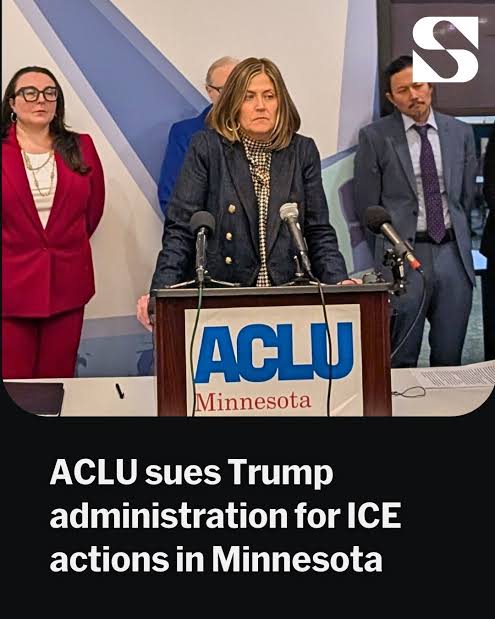
In a significant legal challenge amid escalating immigration enforcement operations in Minnesota, the American Civil Liberties Union (ACLU), along with the ACLU of Minnesota and several partner law firms, filed a class-action lawsuit on January 15, 2026, against the Trump administration. The suit targets the Department of Homeland Security (DHS), Immigration and Customs Enforcement (ICE), Customs and Border Protection (CBP), and related federal officials, accusing them of widespread constitutional violations through suspicionless stops, warrantless arrests, and racial profiling.

The lawsuit, filed in the U.S. District Court for Minnesota, seeks to end what the ACLU describes as a policy of unlawfully seizing and arresting Minnesotans—particularly those perceived to be Somali or Latino—without warrants or probable cause. This practice, according to the complaint, violates the Fourth Amendment’s protection against unreasonable seizures and the Fourteenth Amendment’s guarantee of equal protection under the law.
The filing comes in the context of Operation Metro Surge, a large-scale immigration enforcement initiative that has deployed thousands of federal agents, often in military-style gear and masks, across the Twin Cities region over the past several weeks. The Trump administration’s actions have been linked to inflammatory rhetoric, including the President’s statements referring to Somalis as “garbage” and urging them to “go back to where they came from.”
The class-action suit represents three named plaintiffs—all U.S. citizens—and a broader class of similarly affected individuals. Key allegations include:
Mubashir Khalif Hussen, a 20-year-old Somali-American U.S. citizen, who was stopped by masked ICE agents on December 10, 2025, while walking to lunch in Minneapolis’s Cedar-Riverside neighborhood. Despite repeatedly stating his citizenship, agents allegedly detained him without checking identification, placed him in restraints, transported him to a federal facility, and only released him after fingerprinting—hours later.
Similar incidents involving a second Somali man and a Latino man, including reports of violent takedowns, harassment, and detentions based solely on perceived ethnicity.
These cases, the ACLU argues, reflect a pattern where federal agents target communities based on appearance rather than individualized suspicion, spreading fear in immigrant neighborhoods and affecting even citizens and legal residents.
ACLU attorneys emphasized the broader implications. Catherine Ahlin-Halverson, a staff attorney with the ACLU of Minnesota, stated: “ICE and CBP’s practices are both illegal and morally reprehensible. Federal agents’ conduct—sweeping up Minnesotans through racial profiling and unlawful arrests—is a grave violation of Minnesotans’ most fundamental rights.”
Kate Huddleston from the ACLU’s Immigrants’ Rights Project added: “The government can’t stop and arrest people based on the color of their skin, or arrest people with no probable cause.”
The lawsuit seeks injunctive relief, including a preliminary injunction to immediately halt these practices, as well as the expungement of records obtained through unlawful encounters. It follows other recent legal actions, including a separate ACLU suit addressing excessive force against observers of ICE operations and a state-level challenge by Minnesota Attorney General Keith Ellison.
A Department of Homeland Security spokesperson has dismissed the allegations as “disgusting, reckless, and categorically FALSE,” defending the operations as lawful enforcement.
The case highlights deep tensions over federal immigration policy in Minnesota, home to the largest Somali-American population in the U.S., most of whom are citizens. As protests and reports of incidents continue, the outcome could set important precedents for the limits of immigration enforcement authority nationwide. The ACLU of Minnesota has encouraged affected individuals to report similar experiences via an online form on their website.

BREAKING: Iran’s supreme leader Ali Khamenei is dead after U.S. and IDF strike…

NEW: A U.S. official tells Fox News the strikes on Iran are expected to last for days — not just a few hours. The official and another source also confirmed to Fox News that there were no casualties from Iran’s strike on a U.S. Navy base in Bahrain. The missile hit an empty warehouse.

MIDEAST DIPLOMACY: White House press secretary Karoline Leavitt announced President Trump has spoken with numerous Middle East leaders following the joint US-Israel attack on Iran.

NEW: DHS Secretary Kristi Noem says she is in direct coordination with federal intelligence agencies on potential threats to the U.S. following joint strikes on Iran…

NEW: An FBI official tells Fox News that counterterrorism and counterintelligence teams are on elevated alert nationwide following coordinated U.S.-Israel airstrikes on Iran…

BREAKING: Israeli Defense Minister Israel Katz says Israel has launched a ‘preemptive’ strike on Iran, as Iranian state media report explosions in eastern and northern Tehran.

The USS Gerald R. Ford, the biggest U.S. aircraft carrier, has left port near the Greek island of Crete on Thursday…

STATE OF ALERT: The State Department is allowing non-essential personnel working at the U.S. Embassy in Jerusalem to leave Israel ahead of possible strikes on Iran.

BREAKING: Missiles have been launched from Iran towards Israel, says the Israeli military…

Live updates: U.S. military begins ‘major combat operations in Iran,’ Trump says…

DIVIDED STATES: Sen. John Fetterman said he was likely the only Democrat to shake hands with President Trump at the State of the Union, describing his side of the aisle’s conduct as “disappointing,” adding he found it sad so many of his colleagues didn’t show up…
