
CELEBRITY
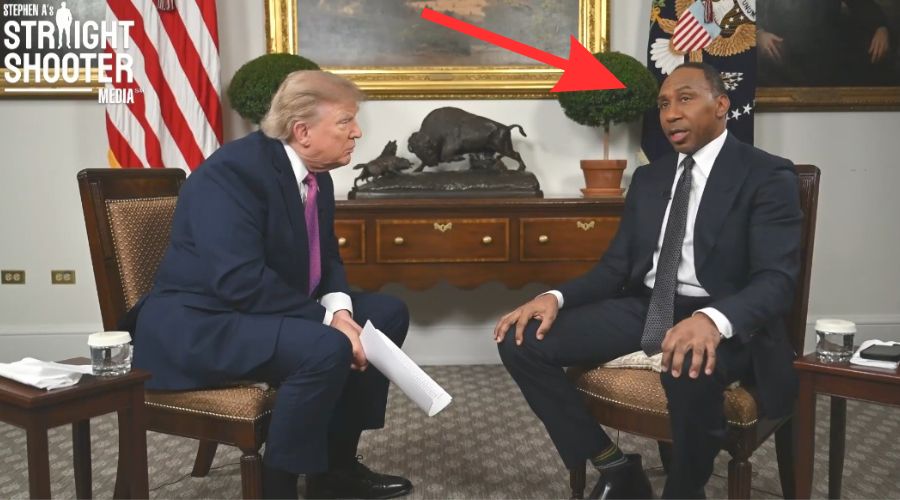
BREAKING: Trump Nearly Loses His Balance During White House Interview with Stephen A. Smith as He Says, “Over 300,000 Lost Their Federal Jobs. You Told Me…” Before Trump Interrupts, “They All Got New Jobs,” but What Stephen Does Next Raises Bigger Questions as He Appears to Signal to Save Trump Before It’s Too Late

BREAKING: Trump Nearly Loses His Balance During White House Interview with Stephen A. Smith as He Says, “Over 300,000 Lost Their Federal Jobs. You Told Me…” Before Trump Interrupts, “They All Got New Jobs,” but What Stephen Does Next Raises Bigger Questions as He Appears to Signal to Save Trump Before It’s Too Late
President Donald Trump found himself facing an uncomfortable exchange during a White House interview with media personality Stephen A. Smith, after the outspoken broadcaster challenged him over the massive reduction in federal government jobs.
What began as a conversation about government spending quickly turned into a tense discussion about hundreds of thousands of Americans whose livelihoods have been affected by the administration’s workforce reductions.
Smith, speaking during an interview for his Straight Shooter podcast, brought up a figure that immediately placed Trump’s economic decisions under scrutiny.
According to the figures discussed, more than 300,000 federal civil service positions have been eliminated since January 2025, raising serious questions about the people left behind.
Rather than allowing the conversation to move past the issue, Smith wanted the president to confront the human consequences of those decisions.
He pointed toward the displaced workers who suddenly found themselves without the jobs, salaries, and financial security they had depended on for years.
For many of those employees, the situation has been particularly difficult, with Black women and longtime civil servants among the groups facing significant disruption.
Smith appeared determined to make the president understand that government restructuring was not simply a matter of removing unnecessary positions from Washington.
Behind every eliminated position was a person, a family, and sometimes an entire household suddenly forced to reconsider its financial future.
But Trump was not prepared to accept the criticism without defending his administration’s approach.
The president pushed back strongly, arguing that the federal government had become excessively large and expensive before he returned to the White House.
According to Trump, the government had reached a point where too many employees were performing work that could reasonably be handled by far fewer people.
He argued that Washington could not continue operating with ten people doing the job of one, presenting the workforce reductions as necessary to restore efficiency.
For Trump, cutting government positions was not something to apologize for but an important part of delivering on his promise to reduce government spending.
However, the president’s response became even more interesting when the conversation turned toward what had happened to the people who lost their federal positions.
Instead of accepting that thousands of former employees were struggling, Trump offered a considerably more optimistic picture of their circumstances.
He insisted that those workers had found new employment, suggesting that they had moved into private sector positions and were doing even better financially.
That response created an obvious opening for Smith, who was clearly not satisfied with the president’s explanation.
The broadcaster pushed back against the suggestion that hundreds of thousands of displaced workers had simply moved into better opportunities without experiencing serious difficulties.
He wanted to understand whether the private sector could genuinely absorb such a massive number of former federal employees.
Smith’s concern was that celebrating the reduction in government spending could overlook the immediate financial consequences facing ordinary Americans.
For someone who had spent decades working in public service, losing a position could mean losing much more than a regular paycheck.
It could affect retirement plans, healthcare arrangements, mortgage payments, children’s education, and the stability of an entire family.
And that was precisely the uncomfortable reality Smith wanted to bring into the conversation.
The president, meanwhile, continued defending the reductions as part of a broader effort to reshape the federal government and eliminate what his administration considers unnecessary spending.
The disagreement exposed two very different ways of measuring the success of the same economic decision.
From Trump’s perspective, a smaller federal workforce represents a government that costs less money and operates more efficiently.
From Smith’s perspective, however, the success of those changes cannot be measured without considering the people who suddenly have to rebuild their lives.
That difference made the exchange particularly revealing, especially because Smith was not simply questioning the president’s decision to reduce government employment.
He was challenging the confidence with which Trump described the outcome for workers who had lost their positions.
The conversation also touched on the broader political consequences of the reductions, particularly for communities where federal employment has historically provided important economic opportunities.
The Washington metropolitan area, for example, has long depended on government agencies and the businesses that support their employees.
A substantial reduction in federal employment can therefore affect more than the individuals directly dismissed from government positions.
Restaurants, housing markets, local businesses, and families can also experience the consequences when thousands of workers suddenly have less money to spend.
That is why Smith’s questions carried significance beyond the immediate disagreement between the two men.
He was highlighting a concern that cannot easily be dismissed with a statement about government efficiency or the possibility of finding private sector employment.
Even when new jobs are available, displaced employees may face different salaries, unfamiliar working conditions, and the difficult process of starting over.
For longtime civil servants, the transition can be particularly complicated because their careers may have been built around public service rather than private industry.
Trump’s confidence that former employees were flourishing therefore became one of the most striking parts of the discussion.
It left Smith with an important question about whether the administration’s positive assessment reflected the actual experiences of the people affected.
Ultimately, the interview demonstrated how difficult it can be to discuss government spending without confronting the human consequences of political decisions.
Trump wants Americans to see the workforce reductions as evidence that he is changing Washington, while Smith wanted attention directed toward those struggling with the consequences.
And although the two men approached the issue from very different positions, their exchange brought an important question into focus.
If hundreds of thousands of federal positions disappear, how can the administration demonstrate that the people affected have genuinely found better opportunities rather than simply being left to fend for themselves?

🚨 TAYLOR SWIFT & TRAVIS KELCE TURN HEADS AT 1587 PRIME! The Newlywed Couple Steal the Spotlight During a Glamorous Date Night as Taylor Dazzles in a Metallic Gown and Shows Off Her Wedding Ring, While Travis Looks Every Inch the Gentleman in His Sharp All-Brown Suit—But Suddenly, an Unexpected Health Scare Leaves the Room Stunned as the Couple Quickly Tries to Shield the Private Moment From Cameras…Watch the moment

BREAKING: Trump Nearly Loses His Balance During White House Interview with Stephen A. Smith as He Says, “Over 300,000 Lost Their Federal Jobs. You Told Me…” Before Trump Interrupts, “They All Got New Jobs,” but What Stephen Does Next Raises Bigger Questions as He Appears to Signal to Save Trump Before It’s Too Late

Donald Trump Collapses After Being Seen Smashing Things in His Office Following Election Defeat and Is Immediately Rushed to the Hospital, Only for Doctors to Confirm that He’s…

🚨 😡💔 Will Smith reportedly crashed out on Instagram Live after his son Jaden was spotted with fashion figure, Michèle Lamy: “I raised Jaden as a Christian, and I did everything I could to make sure he grew up with the right values. Now I’m seeing him associating with someone whose lifestyle I consider completely against everything I believe in all because of money? I cannot have that kind of influence around my family anymore. At this point, I’m cutting him off and disowning him, I cannot keep pretending I’m okay with this.😡👀💔

BREAKING: DONALD TRUMP ALLEGEDLY COLLAPSES AND FAINTS DURING THE NATIONAL VETERANS DAY OBSERVANCE AFTER ARRIVING 5 MINUTES LATE, STAGGERING ON HIS FEET AND STANDING MOTIONLESS BEFORE THE WREATH FOR NEARLY 30 SECONDS! His Visibly Swollen Hand and Sudden Collapse Have Triggered Explosive Questions About His Health, With Critics Now Demanding to Know Whether He Is Still Fit to Serve as President as IMMEDIATE IMPEACHMENT CALLS Begin to Mount! But What Happened Moments Before He Went Down Has Left America STUNNED!

Meghan Markle Caught in an AWKWARD and DISGUSTING Moment at the European Parliament in Brussels During the Opening of the Lost Screen Memorial, as She Struggles to Fix Her Facial Prosthesis Mask While Prince Harry Quickly Steps In! The Bizarre Moment Has Left Royal Fans With So Many Questions as They Keep Replaying the Clip.

29-Year-Old Sydney Sweeney and 49-Year-Old Tom Brady CAUGHT KISSING in New York City as Their VERY CLOSE Moment Leaves Fans STUNNED! The Unexpected Romantic Moment Has Left Fans SHOCKED, With Many Asking What Is REALLY Going On Between Them!

Jennifer Lopez, 57, Turns Heads During a Wild Beachside Getaway at Miami’s Famous South Beach, Spotted Laughing, Stretching Out on Her Lounger and Smoking a Hookah as She Enjoys Every Moment of Her Day in the Sun. But One Detail About Her Relaxed Beach Appearance Has Fans Zooming In.

Taylor Swift and Travis Kelce Join Patrick and Brittany Mahomes for an Exclusive Private Luxury Yacht Celebration Following Their Fourth Baby Announcement! But Just When Everyone Thought the Celebration Was All About the Mahomes Family, Taylor and Travis Drop an UNEXPECTED Surprise of Their Own! Fans Are Still Finding It Hard To Belive.

EXCLUSIVE: Chris Watts’ gay prison sex revealed: Guards catch killer dad and fellow inmate… sordid scene is discovered in cell… and insiders leak his letters to harem of young men who ‘will do anything

Meghan Markle, 45, spotted sharing a deeply intimate moment with Prince William, 44, at a UK beach without Prince Harry and Kate Middleton, unaware they were being photographed, as one shocking detail about Meghan’s look raises big questions
