
CELEBRITY
DIVIDED STATES: Sen. John Fetterman said he was likely the only Democrat to shake hands with President Trump at the State of the Union, describing his side of the aisle’s conduct as “disappointing,” adding he found it sad so many of his colleagues didn’t show up…

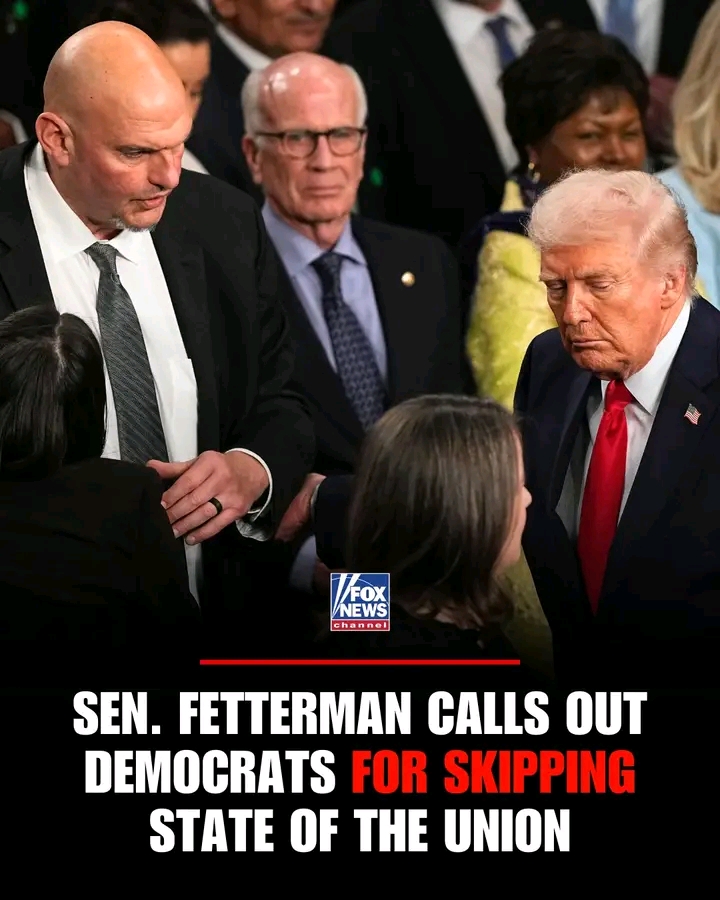
Divided States: Sen. John Fetterman Breaks with Democrats at Trump’s State of the Union
In a striking display of bipartisanship amid deep partisan tensions, Sen. John Fetterman (D-PA) emerged as a rare voice of civility during President Donald Trump’s State of the Union address on Tuesday, February 24, 2026. The Pennsylvania senator revealed that he was likely the only Democrat to shake hands with the president as Trump entered the House chamber, a simple gesture of respect that stood in sharp contrast to the conduct of many on his side of the aisle.
Speaking to Fox News’ “America’s Newsroom” the following morning, Fetterman confirmed the handshake and defended it as a matter of basic courtesy. “Yes, I shook his hand, of course,” he said. “He walked in, and I’m always going to do that, for sure.” He went on to describe the behavior of his Democratic colleagues as “disappointing,” lamenting the absence of many who chose to boycott the event entirely.
“It’s disappointing, honestly,” Fetterman stated. “I mean, I think that’s sad that half of my colleagues didn’t show up.” Reports indicated that dozens of Democrats skipped the address or attended alternative events in protest, while others present engaged in disruptions, including yelling, screaming, holding signs, and heckling during the speech. Some Democratic lawmakers faced removal from the chamber for their protests.
Fetterman, who has increasingly positioned himself as a moderate willing to cross party lines on issues like immigration, border security, and foreign policy, also criticized the disruptive tactics. “I don’t care if it’s a Republican or Democrat, it’s a president,” he emphasized. “Just don’t do that.” He argued that such actions—constant interruptions and outbursts—undermine dignity and fail to advance political goals. “The State of the Union can’t turn into the Springer show,” he quipped in separate remarks, referencing the chaotic nature of some responses.
The senator highlighted moments where he stood and applauded, even when many Democrats remained seated. He specifically noted clapping for victims and veterans mentioned by Trump, questioning why colleagues couldn’t show basic kindness in those instances. “Can’t we just be more kind to a widow? How can’t we acknowledge that?” he asked rhetorically.
Fetterman’s actions and comments underscore a growing divide within the Democratic Party. Known for his unconventional style—often favoring hoodies over formal attire—he notably wore a suit for the occasion, signaling respect for the institution. His handshake with Trump, captured on video and widely shared online, drew praise from some quarters as a return to “old school” civility and criticism from others who viewed it as insufficiently oppositional.
The address itself was marked by sharp partisan contrasts. Trump highlighted achievements on the economy, immigration enforcement, and national security, while railing against opponents and emphasizing themes of American renewal ahead of the nation’s 250th anniversary. Democrats, many of whom have clashed with Trump on policy fronts, responded with visible frustration, leading to the disruptions Fetterman condemned.
In the aftermath, Fetterman’s stance has reinforced his reputation as an independent-minded Democrat willing to prioritize institutional norms over party orthodoxy. Whether his call for greater respect and attendance translates into broader shifts remains uncertain in an era of heightened polarization. Yet, in a chamber where unity is increasingly rare, one senator’s simple handshake served as a reminder that common courtesy can still bridge divides—even if only for a moment.
As Fetterman put it, respecting the office transcends agreement on policy. In today’s divided states, that message may resonate more than ever.

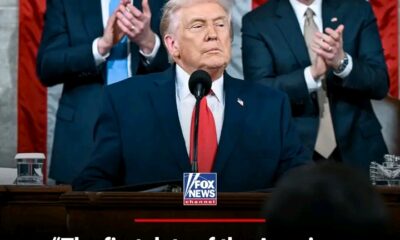


DIVIDED STATES: Sen. John Fetterman said he was likely the only Democrat to shake hands with President Trump at the State of the Union, describing his side of the aisle’s conduct as “disappointing,” adding he found it sad so many of his colleagues didn’t show up…

LET FREEDOM RING: White House Press Secretary Karoline Leavitt shares what Americans can expect during President Trump’s State of the Union address tonight:

President Donald Trump won the 2024 presidential race after his initial opponent, then-President Joe Biden, withdrew over worries about his age and mental sharpness,” writes Aaron Blake…

PRESIDENT TRUMP reiterated his peace through strength foreign policy strategy during his State of the Union address…

‘AMERICA FIRST’: President Trump predicts jobs and investment will flood the country because “we finally have a president who puts America first.”

LINES DRAWN: President Trump says the first duty of the U.S. government is to keep American citizens safe…

The Supreme Court just blocked Trump’s big tariffs plan under emergency powers, ruling 6-3 against him. Raise your hand if you want Trump impeached immediately ✋

“Donald Trump is unfit to be president. He’s corrupt, a serial liar, and he’s covering up the Epstein files,” Rep. Ted Lieu Do you agree with Ted Lieu?

BREAKING: Barack Obama is reportedly preparing to run in the 2028 U.S. presidential election. Raise your hand if you want Obama in 2028 ✋

Senator Mark Kelly: I think Trump was a horrible and failed president in his first term. Then he got re-elected, as a convicted felon, by the way. And I think he has exceeded all expectations about how bad he can be in a second term. 💯 Do you agree with Mark Kelly

Senator Patty Murray’s statement that “Trump is a disgrace” and the “most corrupt president in American history by a long shot” highlights the deep political divide and ongoing criticism of Donald Trump’s presidency…
